

Operation Tiny House Tackles the Affordable Housing Problem for Veterans in Southern Dallas

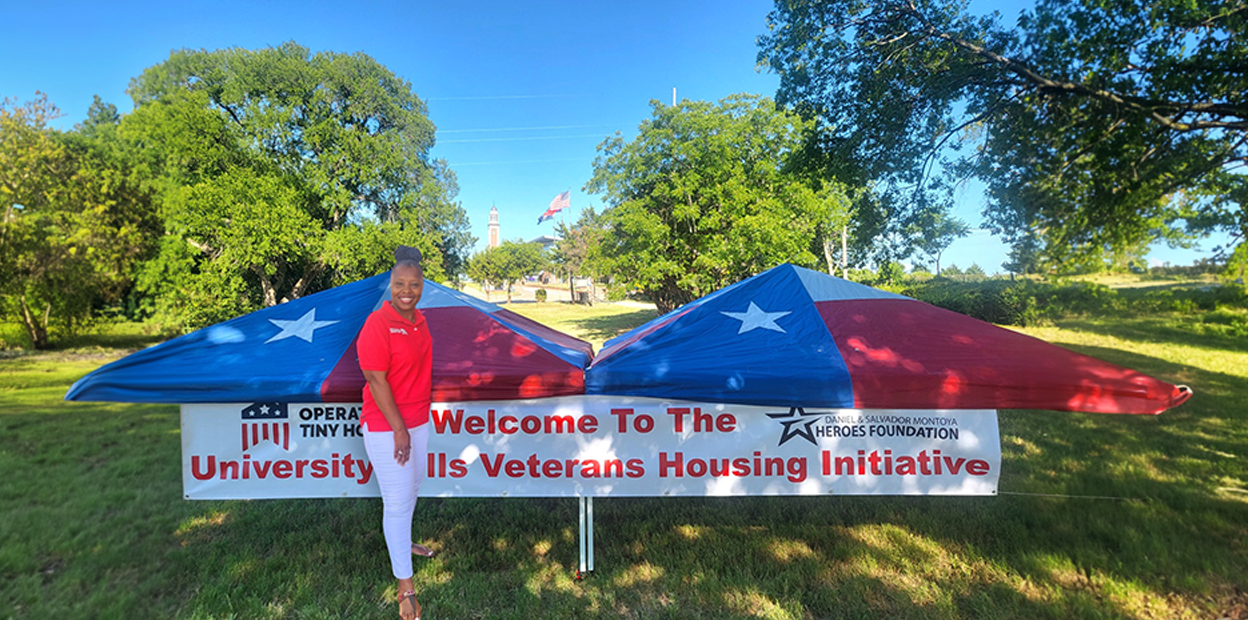
Valerie Ballard is the executive director of Operation Tiny House. Fiscally backed by North Texas Capacity Builders, the organization built six tiny houses in 2019 for a veteran community in Palmer, Texas. Operation Tiny House has also secured a property in Southern Dallas’ University Hills where she imagines job training, retail operations, and housing that will align with zoning restrictions. Her vision is big, which is why she’s thrilled to be part of the Community Developers Roundtable (CDR). For Ballard, it’s a personal mission.
“I knew my father was a paratrooper in the U.S. Army. But it wasn’t until a family reunion that I learned that my grandmother had dedicated her life to taking care of veterans,” Ballard said.
Joanna Webb-Murria graduated in 1935 and began working in Louisiana hospitals, eventually traveling to Vancouver, Washington, Arkansas, and settling in Oak Cliff. Her former home is now known as Joanna’s Veterans Camp. It opened in 2018 and provides transitional housing.
But even though Ballard manages Operation Tiny House and Joanna’s Veteran’s Camp, she didn’t realize how the local homeless veteran problem had grown since the pandemic, until she got a phone call.
“Last summer the veteran’s liaison at UNT Dallas called and said a veteran, who was enrolled and attending classes, had just told her that she had been sleeping in her car at the DART station and couldn’t do it anymore.”
Her story wouldn’t be the last.
“We had a Navy veteran show up at our place — he was also sleeping in his car. We had an opening at the camp, so we got him in there for the short-term and kept working on Operation Tiny House.”
It’s reflective of a national problem, Ballard says. According to HUD, on a single night in 2022, 33,129 veterans were homeless — 28 percent of that total or roughly 9,300, were chronically homeless.
Because this is a pervasive problem throughout the country, the Biden administration is taking aim with new legislation called All-In: The Federal Strategic Plan to Prevent and End Homelessness. The data-driven proposal from the U.S. Interagency Council on Homelessness aims to reduce homelessness 25 percent by 2025. It includes Dallas as one of its first five target cities.
Untreated medical issues, domestic violence, and affordable housing are some of the factors that can result in homelessness. And according to the Dallas Housing Coalition, a 33,600-unit housing gap is expected to grow to 83,500 units by 2030. It’s not hard to see a future with more people will be forced onto the street — and veterans are at higher risk than the general population. Ballard — who has experience in business management and nonprofit development — wants to be solution ready.
“We can’t build fast enough,” she said, speaking at the 11.4-acre undeveloped property in University Hills. They won’t be building tiny houses on this site because of zoning restrictions, but Ballard envisions housing, along with a place for veterans to do job training, as well as retail operations. Operation Tiny House, along with community partnerships to provide wrap-around services, has been folded into the University Hills Veterans’ Housing Initiative (UHVHI) so veterans will have access not just to their own homes, but to jobs, skills training, and even a path to entrepreneurship.
Now that the City of Dallas has installed a sewer line, construction planning can begin. Ballard is organizing a developer’s competition where architects and construction firms will visit to evaluate the project’s potential. Details on timing and getting involved can be found on the Operation Tiny House website. She expects to break ground in 2024; the development is slated to complete in spring 2026.